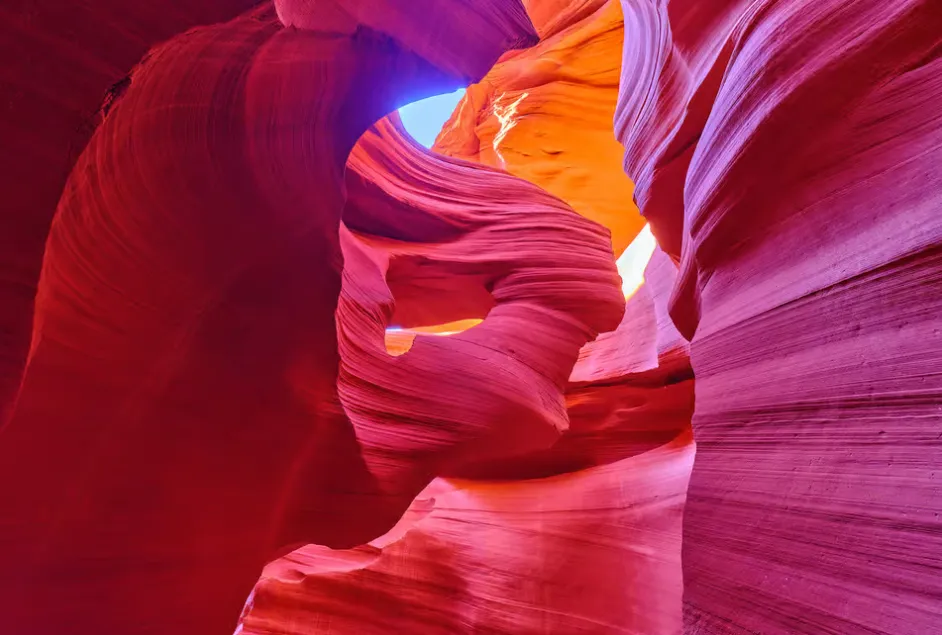
Antelope Canyon looks like something out of a science fiction film — smooth, flowing walls of red and orange sandstone that spiral and curve overhead, with shafts of golden light piercing down from narrow openings above. It's located on Navajo Nation land near Page, Arizona, and it is unambiguously one of the most visually stunning places in the United States. The good news: with the right approach, it's more affordable than most people think.
Upper vs. Lower Antelope Canyon — Which Should You Choose?
There are two separate slot canyons that together make up "Antelope Canyon" — Upper and Lower — and they're run by different Navajo tour operators. Understanding the difference is the most important decision you'll make for this trip.
Upper Antelope Canyon (Tse' bighanilini — "the place where water runs through rocks")
Upper Antelope Canyon is the one you've seen in every magazine, wallpaper, and travel photo — the famous shafts of light beaming down between narrow walls. It's wider, slightly easier to walk through, and produces the most photogenic light beam shots. However, it's also significantly more expensive. Expect to pay $80–$100+ per person for a standard guided tour, with "photography tours" running even higher. Slots sell out weeks or months in advance during peak season.
Lower Antelope Canyon (Hazdistazi — "spiral rock arches")
Lower Antelope Canyon is narrower, deeper, and requires descending into the earth via metal stairways. In many ways, it's just as beautiful as Upper — the swirling patterns, the color gradations, and the intimate scale are equally impressive. But because it doesn't produce the famous light beams in quite the same way (though it does have beautiful light), it attracts fewer visitors. Tours typically run $40–$60 per person — roughly half the cost of Upper Canyon. Ken's Tours is a well-regarded Navajo-owned operator for Lower Canyon, with friendly guides who explain the geology and Navajo history as you walk.
Navajo Nation Land — Guided Tours Are Required by Law
Both Upper and Lower Antelope Canyon are located entirely within the Navajo Nation. By law, all visitors must book a guided tour through an authorized Navajo tour operator — independent visits are not permitted. This isn't just bureaucracy; it's a meaningful rule that funds the local community and ensures the fragile canyon environment is protected.
The authorized tour operators are:
- Upper Canyon: Antelope Canyon Tours (the main operator), Antelope Slot Canyon Tours, various others — book at antelopecanyon.com or through authorized booking sites
- Lower Canyon: Ken's Tours (highly recommended), Antelope Canyon Navajo Tours — book directly via their websites
Tours typically last 45–90 minutes. Your guide will take you through the canyon, explain the geology, point out animal shapes and patterns in the rocks, and help position you for photos. Guides are generally excellent and the experience is far better than wandering alone would be.
Best Time for Light Beams and Visiting Tips
The famous light beams in Upper Antelope Canyon occur when sunlight streams through the narrow canyon opening at a steep angle. This happens most dramatically from late March through early October, with peak light beam intensity around late spring and early summer. Midday tours (around 11 AM–1 PM) produce the best beam effects. If you're visiting specifically for the light, book a midday slot at Upper Canyon between April and September.
Lower Canyon has its own beautiful light effects — the walls glow in deep amber and crimson at any time of day, and the spiral formations are best photographed with the light coming from above. Morning and midday both work well.
- March through October: Best conditions overall, light beams at Upper Canyon
- November through February: Fewer crowds, lower prices, no light beams (sun angle too low)
- Weekdays are significantly less crowded than weekends
- Book tours well in advance — popular time slots sell out in summer
Horseshoe Bend — The Free Bonus Stop
Horseshoe Bend is located just 5 miles south of Page, Arizona and is one of the most dramatic natural viewpoints in the American Southwest — a 270-degree horseshoe curve of the Colorado River carved 1,000 feet below the canyon rim. The view is genuinely breathtaking, and as of recent years, there's a small $10/vehicle parking fee (the overlook itself is free once you're parked). The walk from the parking lot to the overlook is about 1.5 miles round trip on sandy trail.
Horseshoe Bend pairs perfectly with Antelope Canyon — they're 10 minutes apart by car. A standard day trip from Page: morning Antelope Canyon tour, lunch in Page, afternoon Horseshoe Bend visit. Total cost: $40–$60 for Lower Canyon tour + $10 parking at Horseshoe Bend = one of the best $50–$70 travel days you'll ever have.
Page, Arizona as Your Base — Plus Nearby Attractions
Page, Arizona (population ~7,500) is the closest town to Antelope Canyon and makes a practical base for the area. It's a working town, not a resort, so prices are reasonable.
- Hotels in Page: Budget chains like Holiday Inn Express and Hampton Inn run $100–$160/night in summer. Smaller independent motels can be found for $70–$100/night. Book early — Page hotels fill up fast in peak season.
- Glen Canyon Dam: Free to drive across (part of US-89), with a visitor center offering free tours of the dam. The turquoise waters of Lake Powell visible from the bridge are stunning.
- Lake Powell boat tours: If budget allows, a boat tour on Lake Powell through the surrounding canyons is unforgettable. Half-day tours run ~$80–$120/person.
- Wahweap Marina: Renting a kayak or paddleboard on Lake Powell for a few hours is a more affordable water option (~$30–$60).
The nearest major airports are Page Municipal Airport (PGA — very small, few commercial flights), Flagstaff Pulliam Airport (FLG — ~2.5 hours south), or Las Vegas Harry Reid International (LAS — ~4 hours west). Most visitors fly into Las Vegas or Phoenix (PHX — ~4 hours south) and drive, making a road trip out of it.